Monday, March 18, 2013

Lloyd Wildlife Management Area

  
Virginia Bluebells emerging
 
Nature Recycling

Tulip Popular


A group of forest enthusiasts and I visited the old growth forest in Grant county last last week.  This came about because of a discussion a group of us had after a Forestry Webinar series a couple of years ago.  We were interested in seeing what forest looked like that contained really large species.  Dr. Tom Barnes suggested we go to Lloyds Wildlife Management Area because of its close proximity and its collection of really large and diverse population of trees.  He was right there were some impressive trees on the property.  It was apparent however that the forest had taken a rather big setback as a result of the ice  storm a few years back.  The property is about 1100 acres and has a marked trail that loops through the woods. 

On that note now is the time to begin planning those spring wildflower walks.  We noticed a number of tiny wildflowers flourishing in the woodlands at this early part of the season.   Always look down when your not looking up in the woodlands,there is a lot you can miss when you're missing something else.


Thursday, March 14, 2013

Pruning Fruit Trees

Young Apple Before Pruning
One of the more popular posts on this blog is the one dealing with fruit tree pruning.  Nothing beats a handson training when learning the trade.  To that point Dave Kessler, ag agent for Marion County, has organized a fruit tree pruning demonstration for March 22nd in Marion County.  Call the Marion County Extension office at (270) 692-242 for times locations and details. 

General rules when it comes to any pruning are as follows:
  • Start by removing any damaged branches
  • Next remove anything that crosses another branch
  • Young Apple After Pruning
  • Now remove all water sprouts (fast growing straight up branches) and the majority of the interior small branches
  • Finally you will make cuts that increase air flow, incrase spacing for future hanging fruit and sunlight penetration and overall form. 
  • An apple, and pear will be pruned to a central leader, while a peach, plum, cherry, and others will be more open and vase shaped.

Thursday, February 28, 2013

Pruning Blackberries

Pruning blackberries can be tricky because you have floricanes and primocanes, mechanical damage and even insect damage.  This time of year it is faily simple to tell wich canes are alive and wich are dead.  Remove the dead canes first (this will be the ones that had fruit on them last year).  Next remove the spindly canes and anything broken or crossed.  Tip back branches on the extrememly long shoots and continue to the next plant.  For a more detailed description of bramble pruning see Growing Blackberries and Raspberries in Kentucky
Before Pruning
After old cane removal and tipping back
Before Pruning


After Pruning

Friday, February 22, 2013

Theodore Klein award winning plants

Crytomeria japonica 'Yoshino'
In the state of Kentucky we are lucky to have a committee of very qualified individuals review many plants over the years and provide us with a list that would make any landscape proud.  These award winners are selected based on the selectors practical experience with these plants and the plants qualitites being proven in various parts of the state.  In other words we know the plants work and provide lots of good attributes.  The following is a list of the 2012 award winners but by clicking on Theodore Klein you can see all the winners since 1999. 
  • Amsonia tabernaemontana ‘Blue Ice’
  • Calamagrostis x acutiflora ‘Karl Foerster’ 
  • Cryptomeria japonica ‘Yoshino’ 
  • Hypericum x ‘Blue Velvet’ 
  • Lagerstromia indica x faueri hydrids. Examples: ‘Acoma’, ‘Hopi’, 'Nachez'

Thursday, February 14, 2013

New Varieties to try in your Kentucky Garden

At every Land Grant Institution across the United States research is happening on many ideas, methods, crops, etc.  Here at the University of Kentucky researchers in the Department of Horticulture in the College of Agriculture take a look annually at the best varieties for our home gardens and landscapes. On many of these they look at the yield, flavor, disease and insect resistance as well as a whole host of other attributes.  The following is a list of just a few of the varieties that warrant a trial at your place this year:
  • Rabbiteye Blueberries varieties Powder Blue, Spartan, and Onslow
  • Spring Turnip varieties Hakuri and Purple Crown
  • Hardnecked Garlic variety Music
  • Bell Peppers varieties Alliance, Archimedes X3R, and Lafayette
  • Sweet Corn variety Obsession II (glyphosate resistant) 
For more information the varieties trialed this past year at the University of Kentucky take a look at the 2012 Fruit and Vegetable Research Report.

Tuesday, February 05, 2013

Living Simply: Getting Back to the Basics

Building on the popular series of classes from last year Dayna and I are introducing the new series for 2013 called Living Simply: Getting Back to Basics.  This year we will tag team each topic while sharing the how to do information as well as the why to do it information (nutritional info., cost saving info., etc.)  This series will be monthly on the third Thursday of the month beginning at 5:30pm.

  • February 21: Nature’s Candy: Learn what fruits are best to grow in Nelson County, then learn about the benefits of eating these fruits and different ways to prepare them! 
  • March 21: Gardeners and Grandkids: Want to spend more time with your grandkids? Grow a garden with them! Give your grandkids the memories of gardening with you.
  • April 18: What’s In Your Pantry?: Learn the best beans to add to your garden, then how to make a meal with them and other staple items in your home.
  • May 16: You Can Can!: Want the basics of home canning? We’ll give you all the answers!
  • No Class in June
  • July 18: Soap Making: Add some lavender plants to your garden and then make your own soap. Great to keep or give as gifts!
  • August 15: Knead some bread?: Learn how to make your own bread and what grains to grow for it.
  • No Class in September
  • October 17: Meats 101: Learn the best cuts of meat, how to cook it, the nutrition of meat, and try a sampling!
  • November 21: Turkey Day Preparation: Learn all about turkey safety, how to cook the bird and how to make side dishes big enough to feed your whole family! We’ll show you how to have the perfect, healthy holiday feast.

Thursday, May 26, 2011

Landscape Problems

I talked about this at about the same time last year but the problem has not gone away.  The scale problem on hollies has only gotten worse when gone untreated.  After a consult yesterday with Dr. Lee Townsend it turns out we are fighting Cottony Camelia Scale.  Cottony camellia scale is a sap-feeding insect that infests camellia, holly, yew, euonymus and maple. Infested plants usually have a significant amount of black sooty mold growing on the sugary “honeydew” or liquid waste produced by the insects.  Heavy infestations may cause the leaves to turn light green in the spring. The easily overlooked flat females, living on the underside of leaves, are about 1/8 inch long, oval and yellowish tan with a brown margin. However, they produce very noticeable elongate white cottony sacs containing several hundred eggs.

Management alternatives:

Light infestations often can be managed by hand-picking and destroying infested leaves. Remove any cottony egg masses found on leaves in mid- to late May.

Prune and destroy more heavily infested leaves and branches when practical.
Crawlers hatch from these eggs from late May through June. They settle on the undersides of the leaves to feed on sap and grow through winter. This is the stage that is most vulnerable to control with insecticides or insecticidal soap. Treatment should be made in late June. Use of insecticidal soap helps to preserve natural enemies of the scale.

Use a superior dormant oil spray during the winter to kill overwintering scales on the foliage.

Monday, May 16, 2011

Whitehall and Locust Grove trip with Master Gardeners

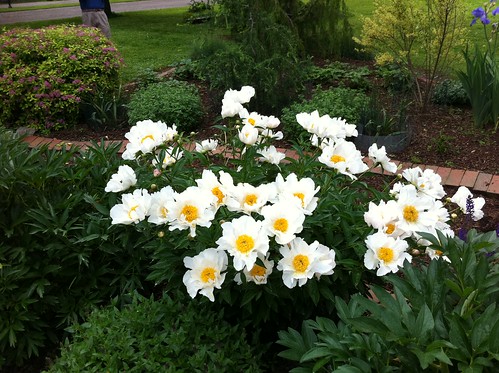
Some of the Master Gardeners and I took a little day trip on Saturday to Louisville to visit the gardens at Whitehall and the gardeners fair at Locust Grove historic home.  We saw some bueautiful sites including the Peonies in full bloom at Whitehall.  The white Peony to the right is called Krinkled White and was an absolutely striking.  This would be considered an open faced single peony.  The pink Peony pictured is called Pink Giggles and I believe the picture says it all. 
The Garden Fair had it all and featured plants from Bob Hills place, and many other locations around Kentuckiana.  It was a wonderful trip for all involved.

Friday, May 13, 2011

Fruit Facts

The April - May issue of Fruit Facts is posted on our Horticulture Web site in the pdf format at:

http://www.ca.uky.edu/fruitfacts/
Please note the Fruit Grower Orchard Meeting scheduled for Thursday, May 19th at Reid’s Orchard in Owensboro.

Articles in this issue include:

Fruit Crop News
Upcoming Meetings
Fruit Grower Orchard Meeting
Scab Infections Are Likely on Apple and Crabapple
Fruit Disease Forecasting Using Kentucky Mesonet Weather Data
KyFarmStart: Kentucky’s Beginning Farmer Program
Fertilizer Price Update
Walnut Bunch Disease
Monsanto’s New Gambit: Fruits and Veggies
Receiving Fruit Facts Electronically on the Internet


John Strang, Extension Fruit Specialist University of Kentucky

Tuesday, May 10, 2011

Emerald Ash Borer

By Lee Townsend


The degree day model predicts the beginning of EAB emergence during this week in central Kentucky; it should reach its peak in about 2 weeks. Individual beetles live for about 3 weeks so adults could be around from mid-May through early July. Adults will feed on ash foliage high in the crown for several days before mating and laying eggs. Suspected infested ash trees outside of the EAB quarantine area (a triangular are bounded by Lexington – Louisville – Covington and the Body – Greenup county area should be reported to the Office of the State Entomologist (859) 257-5838. Insects suspected of being emerald ash borers can be taken to the Nelson County cooperative extension service office at 317 South Third Street Bardstown KY.

Severe storms over the past several days have knocked down a number of the purple EAB traps. The surveyors will be checking and rehanging downed traps so it is best to leave them where they can found and re-set.

Saturday, May 07, 2011

Whats Eating my Oak leaves?

     Oaks can be stripped of their leaves practically overnight by May beetles. Active now, these beetles are approximately 1" long and cylindrical, color varies from brown to black.
     The species which attack oak feed at night, stripping the foliage and leaving only veins. Consequently, the damage is present but there is no sign of the cause. The beetles leave the trees during the day and may be found under leaves or grass around the tree. Sevin is very effective against these insects. The feeding period lasts for several days but one treatment should be sufficient.
     The larval stages are white grubs that feed on the roots of grasses. Large expanses of turf or pasture can produce thousands of these beetles. Fortunately, the beetles are around for only a short time and oaks will push out a new set of leaves.

Monday, May 02, 2011

This weeks Checklist

  • Make sure to get your pre-emergence control down for crabgrass control.  The following is to an article from this blog from not to long ago. 
  • If fruit trees look just a little light in color now would be a good time to apply a little nitrogen fertilize.  Don't apply to much but just enough to add good color.  
  • Keep up spray programs on all fruit especially peaches and strawberries.  Captan will be an important spray during this heavy wet and dark time.  Spray Guide.
  •  I know it is frustrating but make sure you wait until the soil dries out good before trying to plant flowers and vegetables. 

Thursday, April 28, 2011

Inspect your plants before purchasing

With all the rain and gloomy days we aren't just the only things suffering.  As we begin to dry out we will be tempted to go purchase plants to either cheer up the landscape or cheer up the pallate.  Be very cautious when purchasing plants after this monsoon season.  They like us have been setting around doing nothing for several days now and can develop some bad problems.  Don't be afraid to check the root system for good white roots and be sure to cull the plant if you see leaf spotting, wilting, or just overall lackluster conditions. 

One problem we need to be particularly diligent on occurs on our Tomato plants.  A disease called late blight has shown up extremely early over the last two years and with the weather we have had we can expect to see this issue again.  http://www.ca.uky.edu/agcollege/plantpathology/ext_files/PPFShtml/PPFS-VG-14.pdf

The link above will give you much more insight as to what to look for and the images are shots of late blight on transplants.

Wednesday, April 27, 2011

Wet weather stirs up insects


LEXINGTON, Ky., (April 27, 2011) – As rain continues across the state, insects may find their way into people’s waterlogged backyards, homes and landscapes.


     “There are insects and their relatives that thrive under most any set of conditions; this spring belongs to the ‘water bugs,’” said Lee Townsend, extension entomologist in the University of Kentucky College of Agriculture.

      Some of the biggest wet-weather nuisances are floodwater mosquitoes. These mosquitoes lay eggs in low-lying areas and wait for spring rains. Adults emerge around two weeks after a heavy rainfall—ready to eat. They may travel as far as 10 miles away from their breeding site in search of food.

       Two of the most common are the floodwater mosquito and the inland floodwater mosquito.

       The inland floodwater mosquito is a significant pest in Western Kentucky that can spawn several generations each year. The mosquito strikes its victims mainly at dusk or just after dark.

       The floodwater mosquito is active from late spring through summer. It is most active in the early evening and has an irritating, painful bite.

      “Fortunately, except for dog heartworm, they are not significant disease carriers,” Townsend said.

       Mosquitoes can be avoided by staying indoors when the insects are most active, wearing light-colored, long-sleeved clothing and using insect repellent.

       Wet weather also brings several arthropods indoors including clover mites, springtails and ants.

       Only 0.03 inches long, clover mites look like moving dark spots to the naked eye. Clover mites will not harm people or pets but are considered nuisances because they often are found in large numbers and leave a red-brown stain when crushed.

       The grass-eating mites are always present in lawns, but thrive during cool, wet springs or in excessively fertilized turf. They will crawl up outside walls and enter homes around doors or windows.

       If found indoors, wipe the mites up with a soapy rag or wet sponge being careful not to crush the mites and cause stains. The crevice tool of a vacuum is useful in mite removal too.

      Outdoor preventive measures include keeping turf trimmed and avoiding over fertilizing.

       Like the clover mites, springtails could be numerous in humid or moist areas around homes and landscapes. They typically enter homes at the foundation, doorways or at basement or crawlspace openings.

      The springtails will die in dry air. If springtails are persistent in a home, there’s likely excess humidity or moisture. A key to controlling springtails is to reduce the humidity or moisture in your home by improving air circulation. A dehumidifier or air conditioner may help.

       Another common wet weather home invader is the pavement ant. These ants often build their nests along building foundations, concrete slabs or sidewalks and enter homes through cracks or openings. The ants have an indiscriminate palate, eating everything from dead insects to greasy foods to pet food. Oftentimes, they’ll form a trail from their colonies to their food sources. To effectively control the ants, homeowners should locate and directly treat their mound-shaped nests. Overtime, ant traps will destroy the whole colony. Homeowners also can treat an infestation by applying insecticide directly to the nest.

       In addition, it is common for cane fly larvae to appear in landscapes in the spring. These larvae resemble cutworms but have no legs or distinct head. The larvae feed on decaying organic matter in wet, shady areas. During excessively wet periods, they come out of the shaded areas and become visible on sidewalks or driveways. Neither the larvae or adults, which look like mosquitoes, are harmful, but large numbers of these could mean an area is constantly wet or has too much organic matter, which could lead to other problems.

Tuesday, April 19, 2011

Shiitake Mushroom Production Workshop


Dr. Deborah Hill will teach a workshop on shiitake mushroom production April 25, 6:30 at the Nelson County Extension Office. You will learn the entire process of production from inoculating logs to harvesting.  You will take home innoculated logs that you will begin to harvest in a few weeks.  The class is $15 and space is limited. Call the extension office, 348-9204, to reserve your log.

Monday, April 18, 2011

Eastern tent caterpillars are visible in trees now. Burning them out is not the answer but control should be attempted. Many homeowner insecticides will work well to control them. During early detection times a bacillus Thuringiensis product like Dipel will work well. Otherwise you will need to use one of the permethrin type products.  Below is a link for more specific information on this inscect.  http://www.ca.uky.edu/entomology/entfacts/ef423.asp

Tuesday, April 05, 2011

Pruning Peaches

Peach trees should already be pruned or least in the pruning process.  The collage of pictures below show a good progression of how a tree should look from beginning to end.  General rules include:
  • Begin with broken or dead limbs
  • Remove anything that crosses
  • Develop the scaffold branches
  • Open the interior in order to get plenty of light into the Middle

Monday, April 04, 2011

Crabgrass Control

Crabgrass applications should be made now.  The first application of crabgrass control needs to be applied by the middle of April.  This is an attempt to get the early germinating seeds and to have the product in place prior to the peak germination period which occurs during the middle of May til June.  In a normal year one application of a pre-emergence herbicide is all that is required.  However in a year like last year a second application of pre-emergence was needed along with a follow up post emergence application.  Crabgrass is a much bigger issue in lawns that are thin or have a low plant population.  Keeping your lawn in good vigor is very important but in some years easier said than done.  Weed Control Recommendations for Kentucky Bluegrass and Tall Fescue Lawns

Pre-Emergence Control of Annual Weed Grasses:  Crabgrass, Foxtail, and Goosegrass

benefin + trifluralin (Team)
bensulide (Betasan, PreSan, Lescosan)
oxadiazon (Ronstar)**
pendimethalin (Weedgrass Control, Pre-M, Halts, Pendulum)
dithiopyr (Dimension)
prodiamine (Barricade)
bensulide + oxadiazon (Goosegrass/Crabgrass Control)**

Friday, March 04, 2011

Grafting Workshop

Last night we had around 25 folks out to learn more about what I call the "art" of Grafting.  It really takes practice and practice to get this right but when you do it is a really good feeling.  Most folks were able to take home 3 or 4 trees after getting a lesson on the why and how of grafting from University of Kentucky Fruit specialist Dr. John Strang. 


Thursday, February 24, 2011